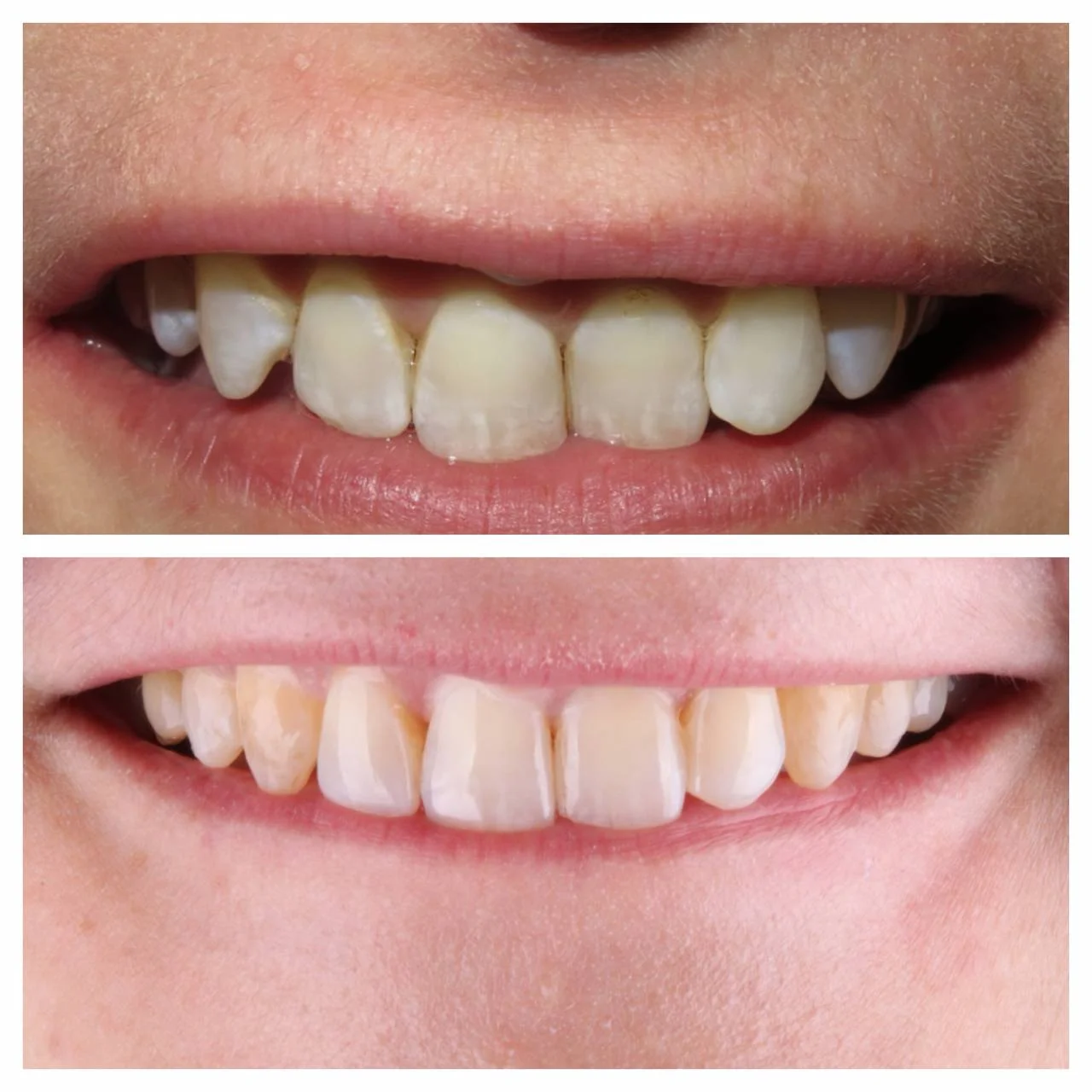
Veneers as the primary treatment. The detail below is what we'd walk you through if you came in with a case like this one.
What veneers are
A veneer is a thin layer of porcelain bonded to the front of a tooth. About half a millimeter thick. The craft is in what you don't notice: the translucency at the edge, the surface texture under light, the way it sits against the lip when you smile.
Porcelain matched to your skin, your age, your hair. Not whiter than nature. What nature would have given you.
When veneers fit
Chipping. A front tooth that has been bonded and rebonded until it looks tired. Shape that bothers you in photos. A shade whitening can't reach — old tetracycline staining, internal discoloration, a non-vital tooth that has gone grey.
Mild crowding is sometimes the case for veneers too. A tooth that sits slightly behind the others, a rotation small enough that porcelain can give the line of the smile back without orthodontics. And refreshes — old work the rest of the face has aged past. The work isn't failing. It's just done.
When they don't
Whitening alone, if the issue is only shade. Cheaper, faster, and nothing irreversible. Invisalign first when the crowding is real — porcelain on top of crooked teeth is camouflage, not correction. Bite work before cosmetic when enamel is being lost; porcelain bonded onto a problem doesn't fix the problem.
I'd rather tell you no than do work that won't hold up. For more on the choice between the two, see veneers or Invisalign?
Same-day or lab-made
Two paths. Same-day laminates are designed, milled, and bonded in one visit — end to end, in the office. Best for one or two teeth, refinements, conservative shape changes. Lab-fabricated porcelain is the longer route: impressions, a design preview, temporaries you live with for two or three weeks, then the final fit.
More steps, more ceramist involvement, more room to dial in. Better for full uppers and complex shade matching across the smile line. The case usually tells you which path. When it doesn't, I will.
Common questions
How long do veneers last? Ten to fifteen years for porcelain, with twenty realistic on a well-maintained case. Composite about half that.
Do veneers ruin your teeth? They permanently change them. A traditional veneer removes about half a millimeter of enamel. That is a deliberate, lifetime decision — the right one in the right case. We talk through the trade-off before any tooth is touched.
How many veneers will I need? Most cosmetic cases use six to ten teeth across the smile line. A single chipped front tooth can be a one-veneer case. The right number is the smallest number that solves the actual problem.